Real Estate
Does Porter Ranch Have Mello-Roos? How to Check Any Address Before You Buy
Updated August 2026
By Porter Ranch Pros — an independent resource for Porter Ranch homeowners.
Some homes in Porter Ranch carry Mello-Roos. Some don't. There is no single yes-or-no answer for the neighborhood as a whole.
Newer, gated, builder-developed tracts are more likely to carry it than older Porter Ranch neighborhoods. That's a pattern, not a rule for any specific address.
There's also no single dollar figure to quote. Every Community Facilities District (CFD) sets its own formula for how the tax is calculated.
The special tax is only one part of what a Porter Ranch home costs to own; for where prices and the wider market stand right now, see our Q3 2026 Porter Ranch housing market update.
The only reliable answer for a home you're considering comes from that parcel's own property tax bill, plus the title and escrow documents tied to it. Checking takes minutes once you have the parcel number — here's exactly how.
What Mello-Roos actually is
Mello-Roos is a special tax levied within a Community Facilities District, authorized under California's Mello-Roos Community Facilities Act of 1982.
The tax funds bonds that pay for public infrastructure: roads, water and sewer systems, parks, schools, community centers, and storm drain and flood control. In some districts, it also funds ongoing services.
Mello-Roos is separate from and in addition to the standard 1% ad valorem property tax under Proposition 13. By law, it cannot be based on a home's value, so it doesn't rise and fall with market price the way the base 1% tax does.
Forming a district requires a two-thirds vote. Where very few registered voters live in the proposed district, that vote can be held as a property-owner election — in some cases, a developer has been the only eligible voter.
A district's tax typically runs 20 to 25 years. By law, it may only be levied as long as needed to pay off the bonds it funds.
Once those bonds are paid off, the tax may end entirely or shift to a smaller maintenance assessment. Which outcome applies depends on that district's formation documents.
An occasional email for Porter Ranch homeowners — seasonal reminders and new guides. Nothing else.
Why two Porter Ranch homes on the same street can have different tax bills
Porter Ranch contains both older, established neighborhoods and a large amount of newer, gated, builder-developed housing. Newer gated and builder-developed collections are more likely to carry a CFD; many older Porter Ranch tracts do not.
That split is the main reason two homes a few doors apart — built at different times, by different developers — can land on entirely different tax bills.
Even within a single CFD, the amount isn't uniform. Each district has its own Rate and Method of Apportionment (RMA), the governing document that sets the formula, any annual escalation, the maximum rate, and prepayment options.
Formulas have been based on factors like square footage or bedroom count. Different areas or land uses within the same district can be taxed at different rates.
There is no single Porter Ranch figure. Each CFD sets its own formula — which is why the real question isn't "does Porter Ranch have Mello-Roos," it's "does this specific house have it, and how much."
What a builder's "no Mello-Roos" claim does and doesn't tell you
Toll Brothers has marketed its Hillcrest collections in Porter Ranch as featuring "No Mello Roos, low property tax and low HOA fees." That's the builder's own marketing claim about its own communities — worth noting, but not an independent finding about Porter Ranch as a whole.
A claim like this typically covers the specific collection or phase it's attached to. It doesn't necessarily cover every neighboring tract, or even every future phase of the same development.
It's also not a substitute for pulling the actual parcel tax bill on the address you're considering. Treat any builder's tax or fee claim as a starting point for verification, not the final answer — here's exactly how to do that.
How to check a specific address — step by step
Step 1: Find the property's AIN
Every Los Angeles County parcel has an Assessor's Identification Number (AIN), also called the parcel number or APN.
Look it up by address through the LA County Assessor's property search at assessor.lacounty.gov. It also appears directly on the property tax bill.
Step 2: Pull the parcel's property tax bill
Use the AIN to pull the parcel-specific tax bill through the LA County Property Tax Portal at propertytax.lacounty.gov.
This bill is the authoritative record of what's actually being charged on that property — not an estimate.
Step 3: Look for the CFD line item
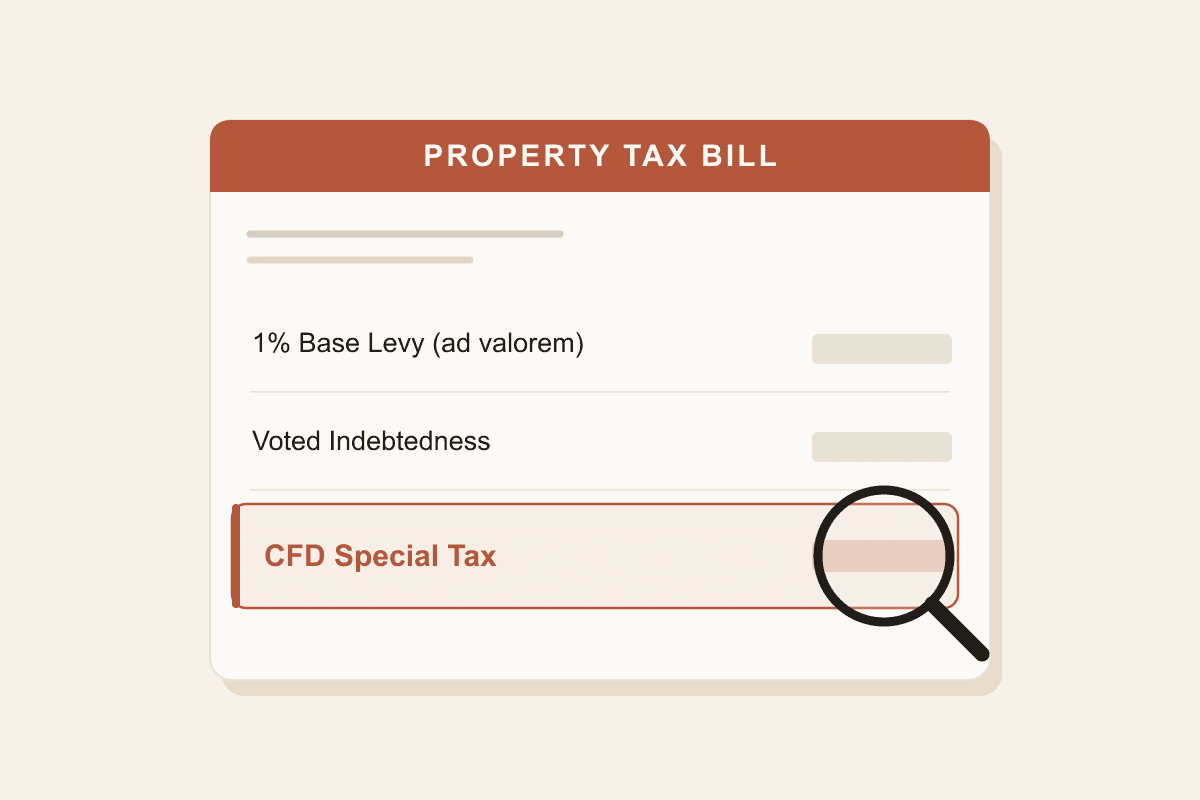
Scan the bill for a line item separate from the base 1% tax. Mello-Roos commonly appears labeled "CFD" followed by a fund number, "Community Facilities District," "CFD Special Tax," or the district's formal name.
Step 4: Check the preliminary title report
The preliminary title report often references any recorded CFD notices or liens tied to the parcel. This is a second, independent place the tax should show up if it applies.
Step 5: Ask escrow or title for the RMA and Notice of Special Tax
Escrow and title companies can pull the Rate and Method of Apportionment and any recorded Notice of Special Tax for the specific parcel.
These documents spell out the actual formula, the current amount, whether it escalates, and prepayment terms — not just whether a tax exists.
Step 6: Call the Auditor-Controller's Direct Assessment Unit if anything is unclear
Three LA County offices each handle a piece of this. The Assessor values property and holds parcel details. The Auditor-Controller adds direct assessments to the tax roll and applies the rates. The Treasurer and Tax Collector issues the bill and collects payment.
If a line item is unclear, call the Auditor-Controller's Direct Assessment Unit at (213) 893-2344 or email dainquiry@auditor.lacounty.gov.
Each special district, including a CFD, provides the Auditor-Controller with a list of parcels and amounts to charge each fiscal year, along with a resolution authorizing the charge. Seller and listing disclosures typically note special taxes too — but verify independently using the steps above rather than relying on disclosure alone.
What the line item on the bill looks like
A California property tax bill is built in layers. The base is the 1% ad valorem levy under Proposition 13, calculated from the home's assessed value.
Below that, separate lines cover voted indebtedness and direct assessments. A Mello-Roos CFD special tax falls into this second category — listed on its own line, not folded into the 1% figure.
Look specifically for the words "CFD," "Community Facilities District," "CFD Special Tax," or the district's formal name, printed as its own line item with its own dollar amount. If you don't see any of those labels, that's a good sign — but it isn't proof.
A district can appear under its own formal name instead of a generic "CFD" label, so a clean-looking bill isn't a guarantee. Confirm with the Auditor-Controller's Direct Assessment Unit before you treat the parcel as clear.
One more practical detail: most lenders include the full annual Mello-Roos amount in the escrow impound account and collect one-twelfth of it monthly with the mortgage payment. It's billed annually, but it affects the monthly payment.
Mello-Roos vs. HOA dues — not the same thing
Mello-Roos and HOA dues get confused constantly. They're two separate things.
One is a government tax that shows up on the property tax bill. The other is a private association fee that doesn't appear on that bill at all. A home can have both, either, or neither.
| Mello-Roos (CFD Special Tax) | HOA Dues | |
|---|---|---|
| What it is | A government special tax | A private association fee |
| Who levies it | The Community Facilities District, via the county | The homeowners association |
| Where it appears | As a line item on the property tax bill | Not on the tax bill — billed separately by the HOA |
| What it funds | Public infrastructure bonds (roads, utilities, parks, schools) and sometimes services | Community upkeep, amenities, and association operations |
| How long it lasts | Typically 20–25 years, tied to bond repayment | Ongoing, for as long as the property is part of the HOA |
| Where it's disclosed | The property tax bill, the RMA, and the Notice of Special Tax | The CC&Rs and HOA documents provided during escrow |
Porter Ranch's newer master-planned and builder-developed tracts commonly carry HOA dues; many older tracts do not — a similar pattern to Mello-Roos, but a separate one.
We do not have verified HOA fee amounts for any specific Porter Ranch tract, so this guide won't state or estimate one. Dues, any special assessments, and the association's reserve health are all disclosed in the CC&Rs and HOA documents provided during escrow — that's the place to review actual numbers for a specific property.
What to ask before you make an offer
These are questions to bring to escrow, title, or the seller — not figures this article can answer for you.
- How much is the annual Mello-Roos special tax on this specific parcel, according to the current tax bill?
- Does the special tax escalate over time, and if so, by how much each year?
- What is the maximum rate allowed under the district's Rate and Method of Apportionment?
- When are the district's bonds scheduled to mature, and does the tax end or reduce once they're paid off?
- Is early prepayment of the special tax allowed for this parcel, and what would that cost?
- What are the current HOA dues, and are there any pending or planned special assessments?
Common questions
Does Porter Ranch have Mello-Roos?
Some Porter Ranch homes do and some don't — there's no single answer for the whole area. Newer, gated, builder-developed tracts are more likely to carry a CFD special tax, while many older tracts do not. The only way to know for a specific home is to check that parcel's own property tax bill.
How much is Mello-Roos in Porter Ranch?
There is no single Porter Ranch figure. Each Community Facilities District sets its own Rate and Method of Apportionment, and the amount can vary even between homes in the same district depending on square footage, bedroom count, or land use. Pulling the specific parcel's tax bill is the only way to get an actual number.
How do I find out if a specific house has Mello-Roos?
Look up the property's Assessor's Identification Number (AIN) through the LA County Assessor's property search, then pull that parcel's tax bill through the LA County Property Tax Portal. Look for a line item labeled "CFD," "Community Facilities District," "CFD Special Tax," or the district's formal name; escrow or title can also pull the Rate and Method of Apportionment and any Notice of Special Tax for the parcel. If none of those labels appear, confirm with the Auditor-Controller's Direct Assessment Unit before assuming the parcel is clear.
Does Mello-Roos ever go away?
A CFD's special tax may only be levied for as long as needed to pay off the bonds it funds, typically 20 to 25 years. Once those bonds are paid off, the tax may end entirely or shift to a smaller maintenance assessment, depending on the district's formation documents.
Is Mello-Roos the same as HOA fees?
No. Mello-Roos is a government special tax that appears on the property tax bill, while HOA dues are a private association fee billed separately and disclosed through the CC&Rs and HOA documents. A home can have both, either, or neither.
Can I pay off Mello-Roos early?
Some districts allow prepayment of the special tax, depending on the terms set in that district's Rate and Method of Apportionment. Ask escrow or title to check whether prepayment is available for the specific parcel, and what it would cost.
This article is general information compiled from public sources — not tax, legal, or real estate advice — and Porter Ranch Pros is not a brokerage. It reflects our own research. Details vary by parcel and change over time, and we may not be completely accurate, so please verify anything here directly with the County and with your own escrow, title, or tax professional before relying on it.
Sources
- California Mello-Roos Community Facilities Act of 1982
- Los Angeles County Auditor-Controller
- Los Angeles County Assessor